 By admin
The modern academic landscape is often described as a battlefield, where the most successful students are those who can sacrifice the most sleep, social life, and sanity. This “hustle culture” has birthed a dangerous mantra: just push through it. We are conditioned to believe that if we aren’t struggling, we aren’t working hard enough. However, this mindset is fundamentally flawed and scientifically inaccurate. When we force our brains to operate under extreme duress, we aren’t actually achieving more; we are merely trading our long-term physical and mental health for short-term, often mediocre, results.
The physical toll of this “never-stop” mentality is most visible in the rising rates of chronic stress and “brain fog” among undergraduates globally. When you are buried under a mountain of research and looming deadlines, the pressure can feel paralyzing, leading to a total shutdown of creative thought. In these high-pressure moments, realizing that you don’t have to carry the burden alone is essential for your survival. Many students find that reaching out to professionals who can help write my paper provides the necessary breathing room to focus on physical recovery and mental clarity without sacrificing their GPA. This isn’t about avoiding the work; it’s about acknowledging human limits and managing your health as effectively as you manage your study schedule.
Our brains are biological organs, not mechanical processors. They require specific conditions—glucose, oxygen, and rest—to function at a high level. When we ignore these needs to “push through” a writing session, the prefrontal cortex begins to falter. This is the area of the brain responsible for executive function, logical reasoning, and complex synthesis. When it is starved of rest, your ability to form coherent arguments or catch simple grammatical errors plummets.
Furthermore, chronic activation of the “fight or flight” response floods the body with cortisol and adrenaline. While these hormones are great for escaping a predator, they are terrible for academic longevity. High cortisol levels over an extended period weaken the immune system, increase systemic inflammation, and actually shrink the hippocampus—the part of the brain responsible for memory. Essentially, by staying up for seventy-two hours to finish a project, you are physically making it harder for your brain to learn new information in the future.
To understand why “pushing through” is a failing strategy, we have to look at the data regarding cognitive retention and error rates. The table below illustrates the stark difference between the traditional “grind” and a health-conscious academic strategy.
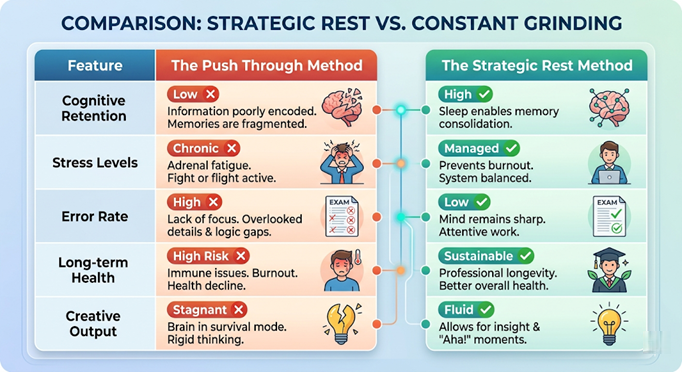
| Feature | The “Push Through” Method | The Strategic Rest Method |
| Cognitive Retention | Low; information is poorly encoded. | High; sleep facilitates memory consolidation. |
| Stress Levels | Chronic; leads to adrenal fatigue. | Managed; prevents long-term burnout. |
| Error Rate | High; lack of focus leads to oversight. | Low; mind remains sharp and attentive. |
| Long-term Health | High risk of heart and immune issues. | Sustainable; supports professional longevity. |
| Creative Output | Stagnant; brain stuck in survival mode. | Fluid; allows for “Aha!” moments. |
This issue is particularly acute in professional fields like healthcare and social sciences. Nursing students, for example, face a unique set of challenges. They are expected to perform physically demanding clinical rotations during the day and produce high-level academic research at night. The emotional labor of caring for patients, combined with the intellectual labor of a rigorous curriculum, creates a recipe for a health crisis.
At some point, the “grind” stops being a badge of honor and starts being a clinical liability. If you are a student nurse struggling to balance twelve-hour clinical shifts with complex theory assignments, seeking professional assistance is a proactive way to manage your mental load and ensure patient safety. By choosing to work with experts from MyAssignmentHelp to write my nursing essay, you are making a strategic decision to prioritize your clinical performance and mental health. This approach allows you to dedicate your limited energy to hands-on patient care and practical skills, where the stakes are highest, rather than collapsing under the weight of an endless pile of academic documentation.
Most students who advocate for “pushing through” are actually caught in a cycle of “revenge bedtime procrastination.” Because they feel they have no control over their daytime hours, they stay up late doing nothing just to feel a sense of autonomy, which only worsens the exhaustion the next day. Breaking this cycle requires a radical shift in how we view academic responsibility.
- Audit Your Energy, Not Your Time: Stop looking at your “to-do” list as a series of hours. Instead, view it as a series of energy drains. If your energy is at 10%, a simple two-hour task will realistically take five hours and be of lower quality.
- Define Your “Hard Stop”: Set a strict time every night after which no academic work is allowed. This “curfew” forces you to be more efficient during the day and ensures your brain has time to enter a parasympathetic state before sleep.
- Utilize External Support: Don’t hide your struggles. Whether it’s a tutor, a therapist, or an academic writing service, using the tools available to you is a sign of intelligence, not a lack of effort.
Universally, the most successful students aren’t those who work the most hours, but those who manage their resources—time, energy, and external expertise—most effectively. In a globalized academic environment where the competition is fierce, the biological human limit remains the same across all borders. The “worst health advice” is thinking you are the exception to these biological rules.
Taking a step back, delegating tasks when necessary, and focusing on recuperation isn’t a sign of weakness; it is the ultimate strategy for academic and professional longevity. We must stop romanticizing the “suffering student” and start celebrating the “sustainable student.” Your degree is a marathon, not a sprint, and if you destroy your health in the first mile, you’ll never see the finish line.
Beyond personal habits, the environment in which you work plays a massive role in your health. A cluttered, poorly lit desk in a noisy dorm room increases the cognitive load on your brain. Your mind has to work harder just to filter out distractions, leaving less power for the actual task at hand. Creating a “sacred” workspace that is used only for focused work can help trigger a flow state more quickly, reducing the time you need to spend “pushing through.”
Furthermore, nutrition and hydration are often the first things to go during finals week. A brain that is dehydrated and running on nothing but caffeine and processed sugar is a brain in crisis. Scientific studies show that even mild dehydration can impair concentration and short-term memory. If you find yourself staring at a blank screen for an hour, the solution isn’t to stare harder; it’s to drink a glass of water and go for a ten-minute walk.
1. Is “pushing through” ever effective for short-term goals?
Ans: In an absolute emergency, a short burst of adrenaline can help you cross a finish line. However, the “crash” that follows often negates any gains made. As a regular strategy, it is entirely unsustainable and leads to a decline in the quality of your work.
2. How can I tell the difference between “normal” tiredness and burnout?
Ans: Tiredness usually resolves after a weekend of rest and good sleep. Burnout is deeper; it’s characterized by emotional exhaustion, a cynical attitude toward your studies, and a feeling of “detachment” where you no longer care about the quality of your output.
3. Does using academic help services lead to “laziness”?
Ans: Quite the opposite. High-achieving students often use these services to manage their time better so they can focus on higher-level learning, internships, or clinical practice. It’s a form of project management that is very common in the professional world.
4. What are the best ways to lower cortisol during a busy week?
Ans: Short, 15-minute sessions of physical activity, deep breathing exercises (like the 4-7-8 method), and ensuring you get at least 7 hours of sleep are the most effective ways to regulate stress hormones and keep your brain in peak condition.
I’m Lucy Wilson, a dedicated academic consultant and researcher with a passion for student wellness and educational strategy. Working with MyAssignmentHelp, I specialize in helping students navigate the complexities of higher education by balancing rigorous academic demands with sustainable mental health practices.